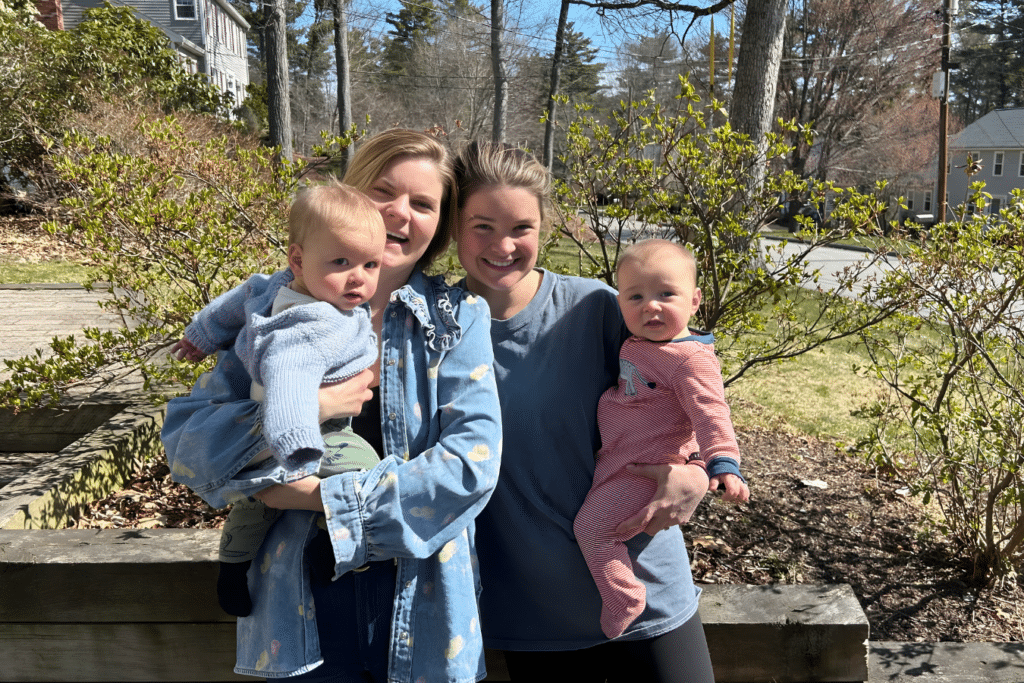
When sisters Molly and Anne said they often ask people to guess who is older, I told them there was no way I was going to take that bait! Laughing, Anne jumped in to explain that her whole life she had simply followed Molly, doing everything she did—just three years later!
The sisters grew up in Vermont, with their brother Robby who is now the quintessential “funcle.” They went to the same college, rushed the same sorority, then both moved to Boston and lived one mile apart. This is a sisterhood that movies are made of.
Eventually, Molly and her husband relocated to the Boston suburbs to start their family, while Anne moved a couple of hours north to southern Maine. True to form, Molly led the way into motherhood.
The most natural part . . .
Molly’s pregnancy with her daughter Macy was going along smoothly until at 30 weeks, Molly’s blood pressure started rising. The mild symptoms started worsening, and at 34 weeks, she was diagnosed with preeclampsia. Ultimately, a doctor’s visit at 35 weeks turned into a hospital stay with a labor induction.
As Molly put it, “Everything was happening both quickly and slowly.” The doctors tried many different methods to get labor started, but nothing worked. After 48 hours, Molly was exhausted, worried and starting to feel desperate. “I turned to my midwife and asked her, ‘Can you be honest, is the only way out of this a C-section? Because if so, let’s just do it.’ Her midwife replied, ‘I’m not in the business of recommending C-sections but in this case, I would.'”
The pre-surgery world felt hazy to Molly, but she remembers clearly when the pediatrician came in before her delivery. “She kindly told me, ‘You are about to have a preemie and after she is born, she will need to go to the special care nursery. We are going to need to feed her and we recommend donor milk. Is that okay with you?‘” For Molly that was more than ok, it felt just right.
“My husband Dan fed Macy her first bottle of donor milk. For me, donor milk was the most natural part of an otherwise unnatural birth experience. It was the best part.”
Successful breastfeeding—and the power of compassionate care . . .
Molly is still so grateful to the hospital staff for how much they helped her and Macy get started on their breastfeeding journey. She describes the nurses and care team as deeply supportive—consistently encouraging her, answering questions, and reinforcing her ability to breastfeed at a moment when confidence felt fragile
With their encouragement, successful breastfeeding began to feel like a chance to celebrate what Molly’s body could do for her baby. It became a bright spot—an empowering win amid a pregnancy and birth so different from what she expected.
“I’m not one to just stay in bed, but my body needed to rest and recover. Instead of feeling stuck, I had this wonderful new thing to focus on. I was there with my baby, feeding her and holding her. Breastfeeding helped me slow down, focus on Macy, and at the same time take care of myself.”
Fast forward two years and both Molly and Anne were expecting, with their due dates just one day apart. Molly was expecting her second child and Anne her first.
Start the music . . .
Anne’s pregnancy had been going smoothly until the final week when she had a high blood pressure reading. Her OB recommended that labor be induced and she agreed to schedule that on her due date. After several hours, labor was fully in motion. “I woke up my husband Jack and said, ‘Hey Jack, we are going to do this. Start the music…”
Labor was intense, and Anne kept pushing. And pushing. And pushing. She pushed for five hours, but her little one wasn’t progressing. Finally, a doctor told her it was too much—they needed to intervene. A C-section or vacuum-assisted delivery was recommended.
Jack and Anne felt more comfortable trying the vacuum-assisted delivery, but it didn’t work. Suddenly, everything changed. Anne’s birth entered crisis mode. She needed an emergency C-section. A team of doctors were ready for the baby, with more doctors and nurses prepping her. It was overwhelming and not at all what she and her husband had hoped for.
Then there was Gus, a beautiful healthy boy. But Anne felt beat up. She felt defeated. Telling the story brought the emotion back and Anne chokes up a little. I see her sister Molly look on with love and concern. Birth is hard. Sisters understand.
Nobody told me about that either . . .
Anne didn’t have a clear plan for feeding her new baby going into her birth. “We took a class on all things birth-related, but they didn’t really cover what happens after the baby is born, or how we would feed him.”
After Gus was born, Anne was exhausted, and her own milk hadn’t come in yet. She felt a wave of relief when the nurses suggested donor milk, knowing she could nourish her baby while her supply developed. Gus received donor milk throughout his three-day hospital stay, and the nurses sent the family home with a few bottles from our “Donor Milk to Go” program, which not only fosters successful breastfeeding but provides emotional support as families begin life with their newborn.
Then after her first night at home, Anne’s milk was suddenly IN. “Holy cow,” she laughs, “What a mess. Nobody told me about that either.” With the help of a lactation consultant, Anne and Gus began their journey toward successful breastfeeding.
When we need it most . . .
Just days earlier, Gus’s cousin Calvin had arrived into the world. This time, Molly’s experience was very different. She was able to labor and deliver vaginally.
“The doctors kept asking me throughout the pregnancy how I wanted to deliver. But I didn’t want to plan a VBAC (vaginal birth after a C-section) and not succeed. And I was really afraid of developing preeclampsia again.” Passing her 35-week mark without any signs of preeclampsia felt like a victory, and once labor began, Molly kept going until Calvin was born.
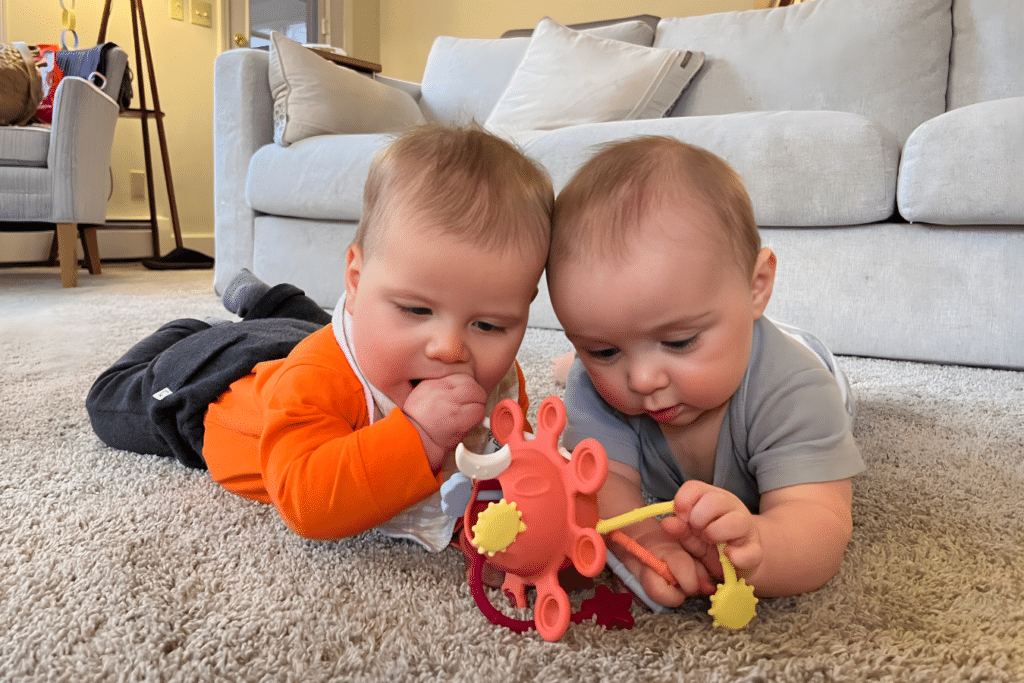
Now, with five-month-old cousins Gus and Calvin, and two-year-old Macy leading the pack, the sisters look for every opportunity to be together. “Anne is fearless,” Molly says. “She just gets in the car with Gus and comes down.” Her delight is unmistakable.
“I feel so lucky. It’s so amazing that our babies both received this gift of donor milk,” Molly tells me.
“It’s completely selfless,” Anne adds. “And it reminds me that we don’t need a scarcity mindset. Everything comes around, when we need it most.”
What’s in your freezer?
Because of this community, more than 22,000 babies across the Northeast received donor milk last year. Have extra milk? Learn more about becoming a donor. Your freezer stash can provide comfort, care, and critical nourishment during some of life’s most fragile moments.