We’re often told that feeding a baby is natural. What we hear less often is that “natural” doesn’t always mean easy. And feeding your baby in the NICU can feel especially overwhelming.
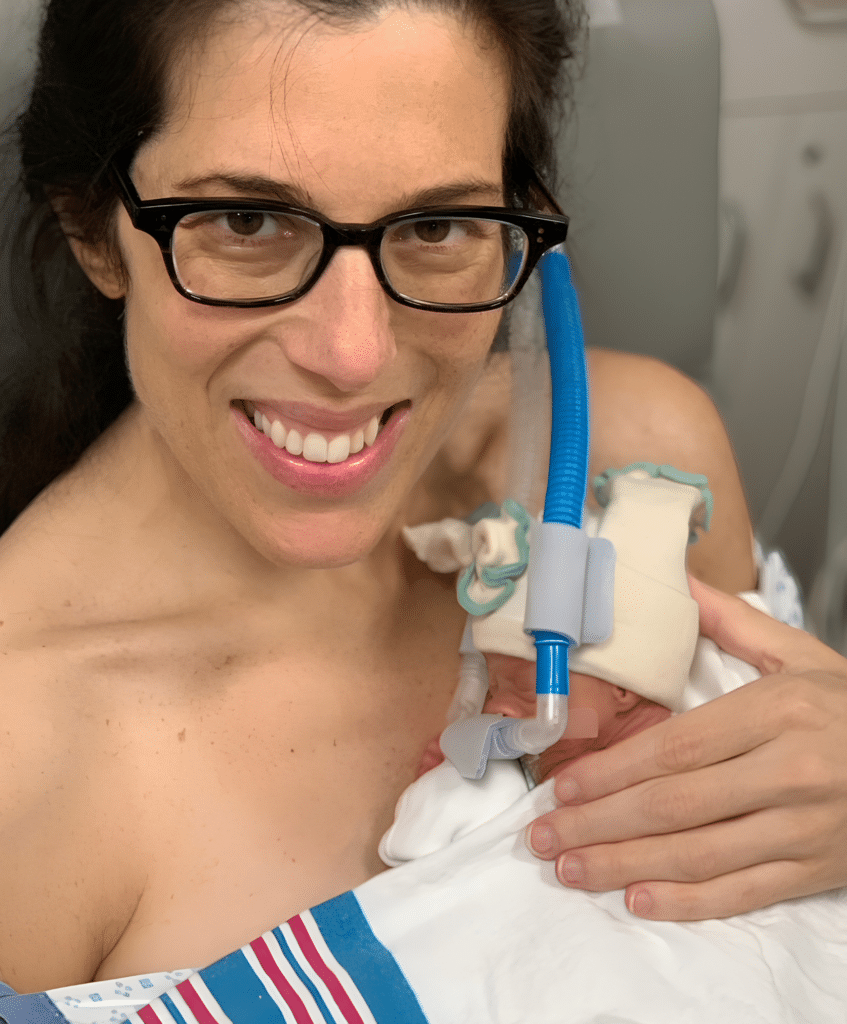
Many of you may remember Jodi, a mom whose daughter, Jenna, was born at 28 weeks, weighing just over two pounds. During Jenna’s 77-day NICU stay, donor milk helped provide the nourishment she needed while Jodi recovered from a life-threatening delivery. Today, Jodi draws on that experience to support families navigating similar challenges through her writing and coaching.
This NICU Awareness Month, we’re honored to welcome her back to share an honest look at one of the most common questions parents face in the NICU: How am I going to feed my baby?
From feeding tubes and donor milk to the emotional ups and downs that can accompany every feeding journey, Jodi shares everything she wishes she’d known at the time. Whether you’re navigating the NICU yourself or supporting someone who is, we hope her reflections offer reassurance, perspective, and encouragement.
Feeding Your Baby in the NICU: What to Expect
By Jodi Klaristenfeld, Founder of FLRRiSH
In theory, feeding your baby is a simple, natural process. But as a NICU mom, you quickly learn that reality is much more complex.
The NICU brings an entirely new set of challenges that can make feeding feel overwhelming, frustrating, and unfamiliar. I’m here to normalize these struggles and reassure you that if feeding your baby isn’t what you expected, you’re not alone.
As a disclaimer, always consult your doctor, qualified nurses, or NICU lactation consultant for medical advice. My goal is to demystify the experience of feeding your baby in the NICU, share helpful statistics, and prepare you emotionally for what to expect.
With that in mind, let’s explore this chapter of preemie parenthood and how to navigate it with confidence, understanding, and self-compassion.
Why Feeding Your Baby in the NICU Is Different
We can’t talk about feeding your baby in the NICU without first recognizing how the experience differs from that of full-term babies. Preemie families and “regular” families are often lumped together even though our journeys are not the same. Let’s dive into the differences and what makes feeding your baby in the NICU unique.
Three Skills for Feeding
Because preemie babies are born early, they don’t have the skills to nurse from their mothers. There are three essential skills required for nursing:
- Sucking
- Swallowing
- Breathing
According to a study from the Belitung Nursing Journal, “The ability to swallow in infants develops from 12 to 14 weeks of gestation, while the ability to suck develops at 14 weeks of pregnancy. The ability to coordinate sucking-swallowing-breathing is not achieved until 34 weeks of gestation.”
The coordination aspect is key here. Before my daughter was born, I didn’t know that learning to sip from a bottle was a very taxing and strenuous task. This is true for all babies, but especially preemies. That’s why it’s not uncommon to see newborns falling asleep while feeding.
How NICU Babies Are Fed
In the NICU, you’ll see babies being fed in three different ways: tube feeding, bottle feeding, or breastfeeding.
Tube feeding can involve several types of tubes: a gastrostomy tube (G-tube) inserted directly into the baby’s stomach, a nasogastric tube (NG tube) passing through the nose and down the esophagus to the stomach, or an orogastric tube (OG tube) going through the mouth and down the esophagus to the stomach.
Occasionally, babies who are very small or sick may get their nutrients from an IV. While this might sound scary, it’s exactly what they need to be healthy and grow.
Breast Milk From Donors
If you’re not able to provide breastmilk for your baby right away, there are alternatives.
In an article by Mother’s Milk Bank Northeast, I was interviewed about my experience in the NICU. After my daughter was born through an emergency C-section, I didn’t see her for two days due to my severe medical state. I had planned to nurse her, but the circumstances made that impossible.
I was relieved to learn that during the two days I wasn’t well enough to visit her, my daughter was being fed donor milk. The nurses explained to me that generous women donate their milk to help babies like mine. Donor milk is the best and safest option for preemies when a mother’s own milk isn’t available. It undergoes strict safety protocols, and the nutrients in the donated milk help protect against other complications.
If your NICU doesn’t automatically offer donor milk, I recommend bringing it up to your doctor to see if it’s an option.
What I Wish I Knew About Feeding My NICU Baby
I’m going to be vulnerable with you for a second. When Jenna arrived at the NICU, I had no idea what was in store. I often wish I could go back in time, tap myself on the shoulder, and explain that despite how challenging it felt, everything was going to be okay.
Since I don’t have a time machine, I’m going to share a few thoughts with you instead. I hope you take my advice to heart and remember it when you start to feel frustrated, overwhelmed, or hopeless about your journey.
It Gets Easier
When Jenna first tried feeding from a bottle, it was incredibly stressful. I knew that if she didn’t take the full feed, they would give the rest through her NG tube, which, in my mind, meant a setback. While setbacks are typical and expected in the NICU, it was still frustrating because all I wanted was for her to come home.
In that moment, I wish I had remembered that the fact she could even master the triad of suck, swallow, breathe was remarkable and a huge accomplishment. It’s so easy to focus on where you’re not versus how far you’ve come, but that’s a topic for another day.
Nursing was equally, if not more, stressful because the nurses weighed Jenna before and after feeds to see how much milk she got. All I could think about was whether enough milk was coming out or if it was too much for her to swallow. What social media told me was supposed to be a “beautiful bonding moment” felt nerve-wracking and uncomfortable.
What I didn’t realize then was that it would get easier. The nurses assured me that once we were home, the experience would be less stressful, more beautiful, and help us bond. And they were right. Feeding her became a much more enjoyable process down the road.
Give Yourself Grace
Nursing is difficult for a lot of people—full-term parents included. So many people glorify it online and make it look easy, but that is not the case for the vast majority.
In the NICU, every little stress feels heightened. You should commend yourself and your baby for all the hard work you do every day. No one really knows how difficult it is until they’ve been through it themselves, so be compassionate with yourself.
To the moms who aren’t able to breastfeed, extend yourself the same grace. There are so many babies around the world who have been formula-fed, myself included. Formula exists because it’s a great replacement for breastmilk, and there should not be any shame around it. Everyone has the right to decide what is best for them and their family.
And remember, there are so many ways to bond and connect with your baby that have nothing to do with nursing. I, for one, hardly nursed when my daughter came home. I was more concerned about getting her the right amount of food.
You are doing the best you can, and that is all anyone can ask for.
Seen. Informed. Supported.
Thank you to Jodi for sharing her story and helping other NICU families feel seen, informed, and supported. Whether you choose to donate milk, make a financial gift, or raise awareness about this vital resource, every act of generosity helps strengthen the circle of care that every baby and family deserves.

From preemie to big cousin — Jenna today!