Breastfeeding may be natural, but that doesn’t mean it’s always easy. Challenges are common, and reaching feeding goals often takes patience, persistence, and support.
As we recognize Breastfeeding Awareness Month, we’re honored to share milk donor Cailee Mathewson’s story, originally published by The Day. It beautifully captures the time, care, and commitment that breastfeeding and milk donation require. Just as importantly, it highlights how support—from family members and lactation professionals to milk donors and milk banks—can help families overcome breastfeeding challenges.
Since this story was first published, Cailee has made several more donations. She has now donated nearly 1,500 oz. of milk—and counting. She knows every ounce matters. And she works hard to make sure the milk she safely collects can nourish a baby.
From Breastfeeding Challenges to Milk Donation: Cailee’s Story
Pawcatuck — In the basement of Cailee Mathewson’s home sits a 7-cubic-foot freezer tightly packed with neatly annotated Ziploc bags that reach nearly to the rim of the chiller.
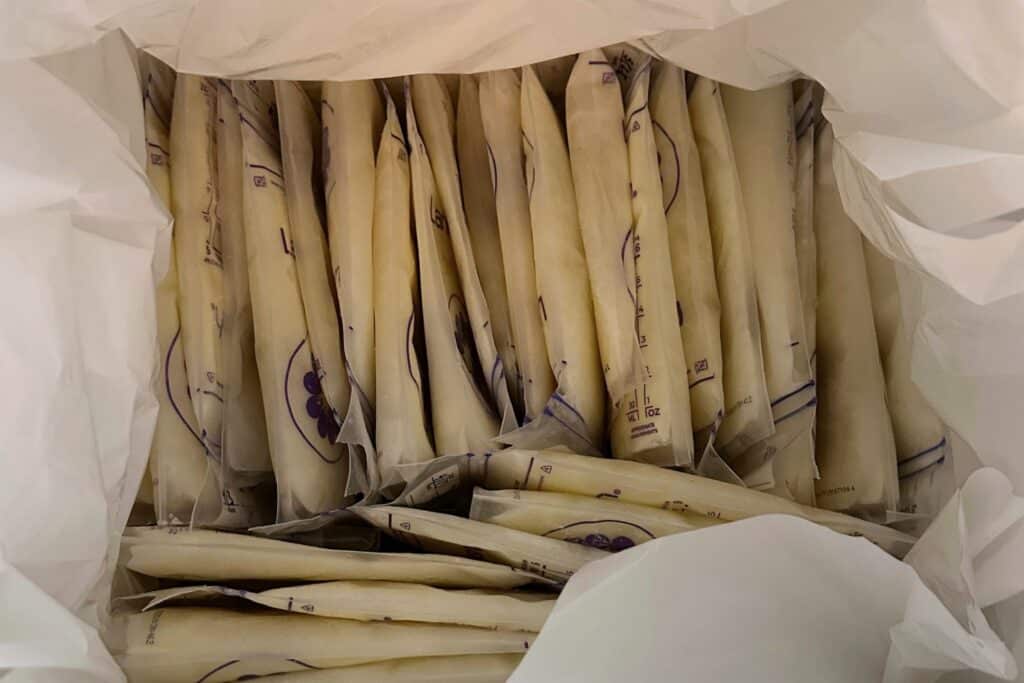
Inside each of those larger bags, marked by weight and date, were several smaller plastic packages. All containing the ounces and ounces of breast milk Mathewson has produced over the last few weeks.
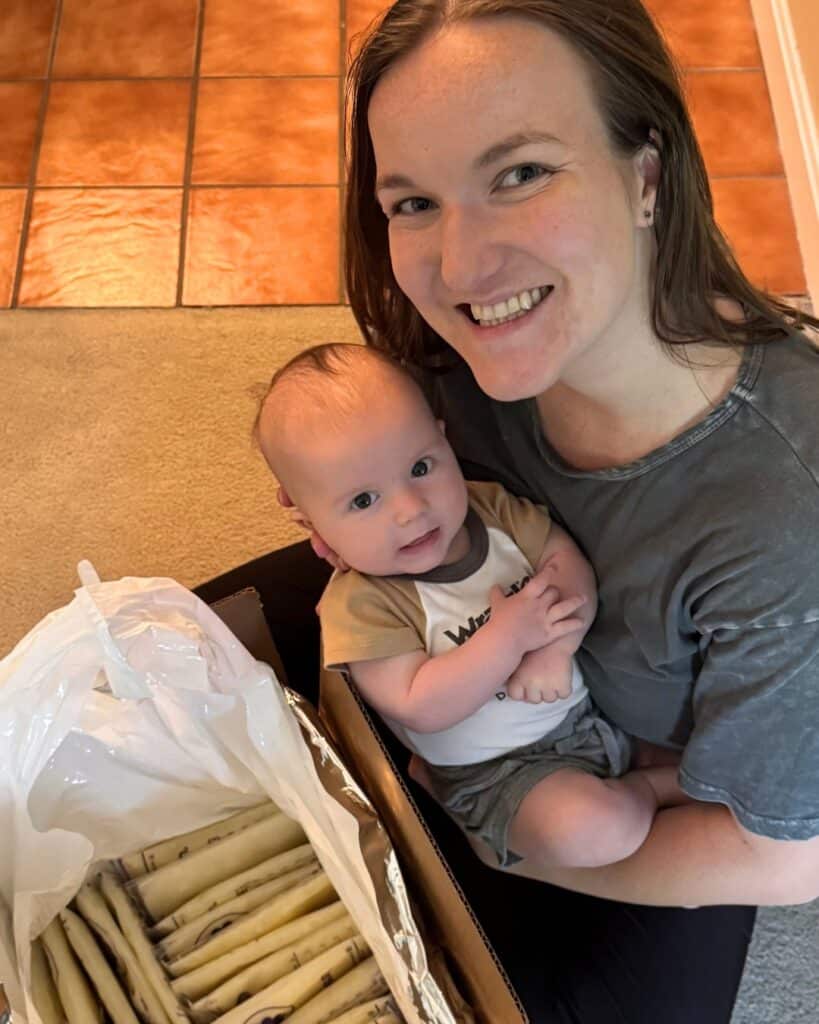
On Monday, Mathewson, a 27-year-old Stonington school system substitute teacher and rowing coach, transferred 362 oz. of frozen milk into an insulated brown box. That nondescript package was later picked up and shipped to the Mothers’ Milk Bank Northeast headquarters in Newton. There, its contents would be documented, pooled, pasteurized, and tested for safety.
Mathewson is one of more than 1,600 Mothers’ Milk Bank donors whose excess milk will be used — likely inside a New England hospital — to ensure premature infants or babies experiencing breastfeeding challenges are properly nourished.
How it Started
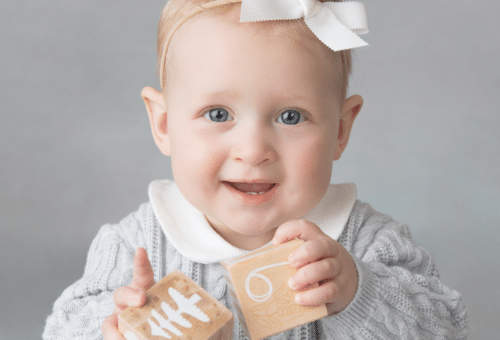
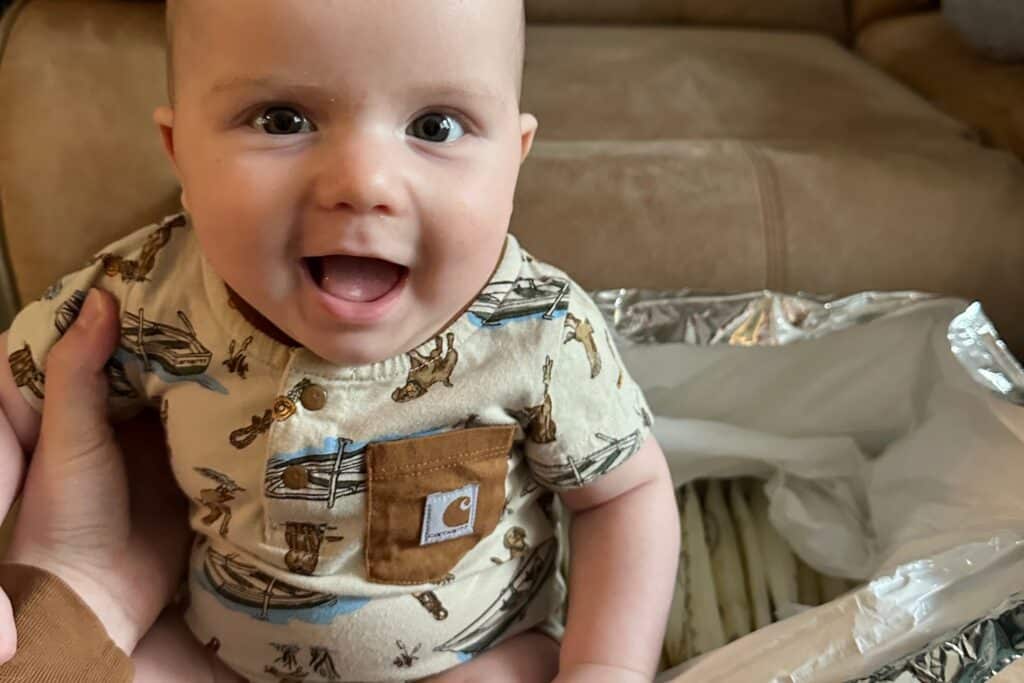
Mathewson’s donation journey began soon after the birth of her son, Maverick Bailey, on Feb. 25 at Lawrence + Memorial Hospital. While the birth went smoothly, issues with Maverick’s tongue and lip made it nearly impossible for the baby to properly latch and feed.
“The first time there was a lot of physical pain — it was killing me — and the first night was so stressful,” Mathewson said. “He was so hungry and just not able to eat enough. He was taking in a lot of air and was choking and gagging.”
Mathewson began using a small syringe to feed Maverick and laser surgery a few weeks later enabled the infant to take bottles. Meanwhile, Mathewson kept pumping and began building up a supply of extra milk that quickly filled a kitchen freezer.
Running Out of Room
“So, we bought the deep freezer and that started to fill up, too,” she said as Maverick smiled and cooed. “We were running out of room.”
A handwritten journal faithfully updated by Mathewson tracked her production amounts by day and week. In the month of May alone, she had produced 1,703 oz. and frozen 791oz.
“I was pumping seven to eight times a day for half-hour sessions each,” Mathewson said. “And it wasn’t just the pumping. There’s the bagging, the cleanup and the storage. It’s a lot faster now. I’ve got six different pumps and I’ve got the pumping down to about 15 minutes, five times a day.”
But all that extra milk was still building up and eventually passed the 2,189 oz. mark. Then, a conversation with her midwife during a six-week checkup alerted Mathewson to Mothers’ Milk Bank Northeast.
Milk Banking – A Discovery
The milk bank supplies donor breast milk to L+M and other local hospitals.
“I went online and put in my medical history and a few days later got a call,” Mathewson said. “Next there was a blood test, screenings, and other forms.”
Mothers’ Milk Bank Northeast’s CEO Deborah Youngblood said her nonprofit organization — one of the largest in the nation — for 20 years has connected donors with families throughout New England. “We serve mainly hospitals and their (neonatal intensive care unit) premature babies,” Youngblood said on Tuesday. “And over the last few years, we’ve been able to meet all the demands those hospitals need.”
In 2025, the milk bank delivered more than 200,000 bottles worth of donor milk to Northeast recipients. Much of that milk is used as a feeding “bridge” for parents who want to breastfeed but need supplemental milk as their own milk is developing. Donor breast milk can also be used if a baby has low blood sugar, is underweight or small; if an infant and mother are separated; or if a baby is jaundiced.
It’s a Process
The donor-to-recipient process is a stringent one. Individual donations are mechanically “pooled” with four others, a mixing process she said results in an optimal product.
“Each mother’s milk is distinctive, depending on a donor’s diet, state of production or medications, and the pooling gives us a standardized product,” she said, adding the pooled milk is pasteurized and tested for bacteria. Youngblood said studies show that breast milk, unlike formula, contains the kinds of bioactive immune-system boosters fragile infants need to thrive.
“We do triage our milk supply so the medically compromised get served first,” she said. “And there’s demand for the outpatient population.”
Helping Families Overcome Breastfeeding Challenges
Jessica Maksim, a lactation consultant at L+M, said the hospital last year provided donor milk to 220 families. She said latching challenges are highly individualized and can be due to physiological issues, in utero positioning, or the age of the infant.
Maksim also runs a regular breastfeeding support group where new moms have a chance to socialize and get parenting advice. She said one member’s baby, who for months struggled to breastfeed, recently latched and is now exclusively breastfeeding.
Today, Mathewson, who met her fiancée, Drew Bailey, more than 10 years ago — “We were high school sweethearts,” she told us — continues to carefully store and rotate every ounce. She keeps a supply on hand for Maverick and donates the rest, knowing every bottle could help a medically fragile baby.
“Seeing Maverick thrive each day is reward enough for the time and effort I put into pumping,” she said. “But knowing so many other babies are also benefiting from my milk is icing on the cake.”